Every roofer passes up to 10 trade and individual related checks.
Free Domestic Use
It is free to use EmergencyLines, pay only the roofer for their service.
Dispatch Guarantee
Every roofer agrees to dispatch within 1hr where possible.
Emergency Roofing in St Albans
St Albans roofs run from Victorian slate around Fleetville and St Stephens to inter-war clay on Marshalswick semis and modern tile on the Jersey Farm estates, all framed by the city's mature trees and the Ver valley. Lead valleys clog with leaf fall, chimney flashing pulls loose on period villas, and one slipped tile across the AL1 and AL3 districts can soak a bedroom ceiling within hours of a storm.
St Albans is an affluent Hertfordshire commuter city of Roman origin around its cathedral and Georgian core, ringed by Victorian and Edwardian villas, inter-war semis and modern estates in the chalk valley of the River Ver. The water is hard and chalky, mature trees shed heavily into gutters and valleys, and ageing soil stacks and dated boards behind period frontages drive much of the work.
Enter your postcode and EmergencyLines finds the nearest available roofer to you - day or night, weekends and bank holidays included. You get a number, you call it, and you speak to the roofer directly. No call centre, no middleman, no waiting on hold.
The roofing year in St Albans
When St Albans roofs tend to fail through the year - and the window to get ahead of it.
AutumnAutumn gales and leaf-fall block gutters and work tiles loose.
Winter29 air-frost days a year drive freeze-thaw into every hairline crack and tired flashing - the peak season for leaks.
Spring-summerThe repair window: clear gutters and put winter's damage right before the next storm season.
Common roofing emergencies in St Albans
These are the roofing callouts we see most across St Albans, shaped by the local housing and weather:
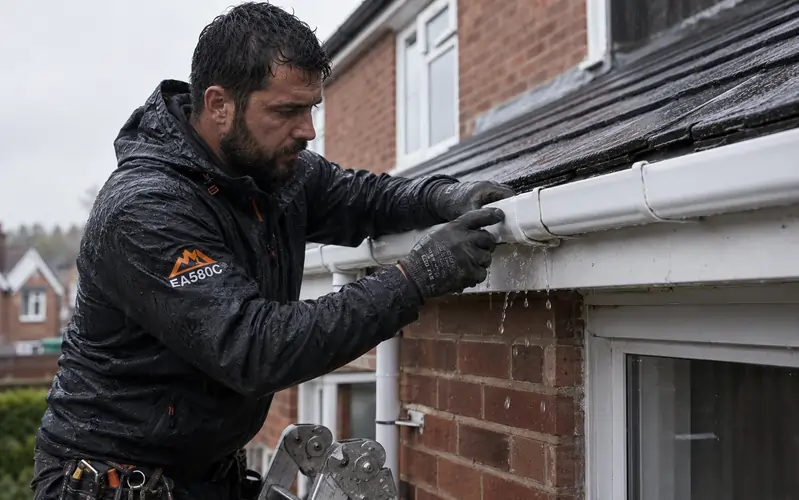
Valley gutters blocked by leaf fall from mature treesHeavy leaf debris off the city's mature trees clogs lead valleys on Marshalswick and Chiswell Green roofs until rain backs up under the tiles.
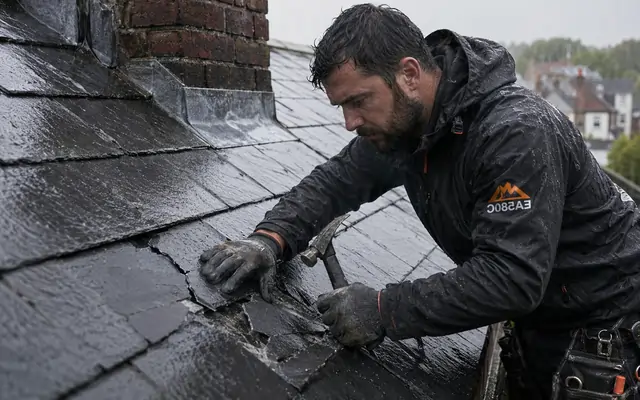
Lead flashing failure around Victorian chimney stacksOn St Stephens and Fleetville villas the mortar-keyed lead pulls from the brick, sending rain down the chimney breast inside.
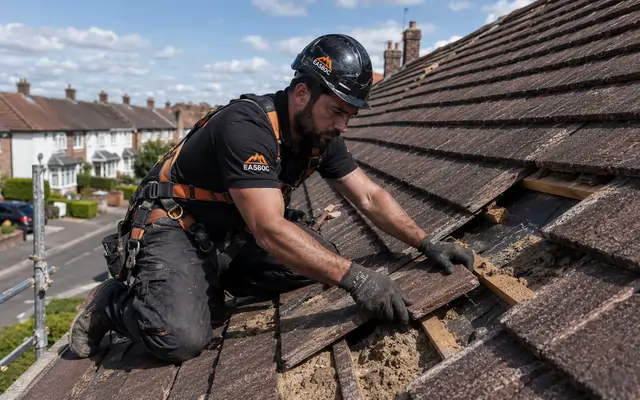
Slipped ridge and hip tiles on inter-war semisMortar bedding on 1930s Marshalswick and Chiswell Green ridges crumbles with age, letting hip tiles slide after a gusty night.
Storm tile loss on exposed Bricket Wood roofsWind through the open woodland at Bricket Wood lifts loosely-nailed tiles on detached roofs, stripping a course in one gust.
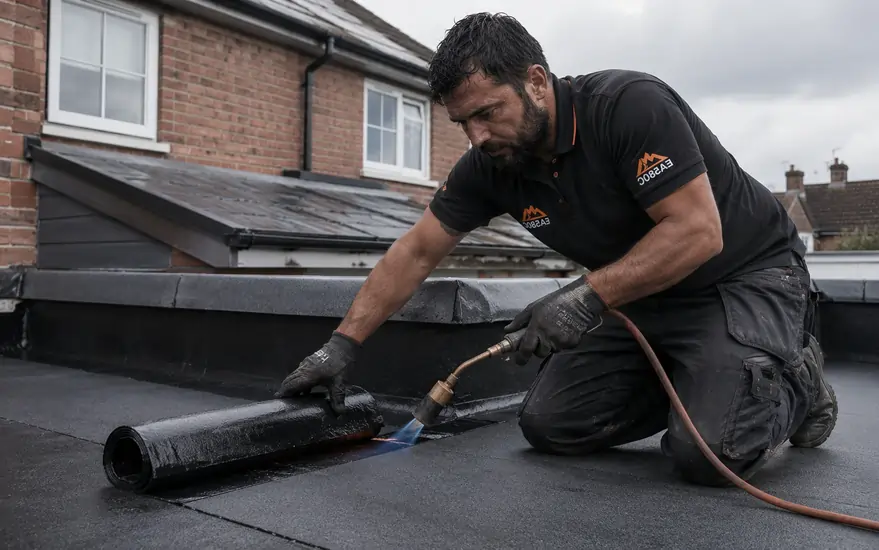
Bay and porch flat roofs leaking on period villasFelt bay roofs on St Stephens villas pond and split along the seams, dropping water onto the window heads below.
Valley gutters blocked by leaf fall from mature trees and lead flashing failure around Victorian chimney stacks come up again and again here - usually down to the age and style of St Albans's housing. Whatever the cause, the priority is the same: a verified roofer covering St Stephens, Verulam and the rest of the city can make it safe quickly and tell you the cost before any work begins.
Roofs and weather in St Albans
St Albans's roofs are mostly natural slate pitches with lead valleys and flashings; clay-tile pitches and bay-window roofs; concrete interlocking tiles, with felt flat roofs on extensions and garages - and with 750 mm of rain a year, a slipped tile or a tired flat roof soon turns into a leak.
Typical roofsnatural slate pitches with lead valleys and flashings; clay-tile pitches and bay-window roofs; concrete interlocking tiles, with felt flat roofs on extensions and garages
Annual rainfall750 mm
Air-frost days29/yrfreeze-thaw on tiles & flashing
Sources: Water-supply hardness by postcode area (mg/l CaCO₃), UK water companies; Open-Meteo ERA5 reanalysis, 2015-2024 daily means (air-frost days & annual rainfall); Build-era profile derived from local housing stock.
Quick check: what's it doing?
Pick what's happening and we'll give you the likely cause and the safe first step - then enter your postcode to reach a verified St Albans roofer.
Act now
Likely cause: A live leak - usually a slipped tile, failed flashing or blocked valley letting rain track in.
Do this now: Move valuables and put a bucket under it; do not go up on a wet roof. Get a roofer out before more rain.
Same-day
Likely cause: Nail fatigue or storm uplift has stripped a course, leaving the felt exposed.
Do this now: Stay off the roof and book a temporary cover - especially if more wind or rain is forecast.
Same-day
Likely cause: Felt or EPDM has split at a seam, or the falls have sagged so water stands and finds the joint.
Do this now: Clear any obvious debris from the outlet; get the seam patched before it tracks inside.
Same-day
Likely cause: A blockage or a failed joint is sending water down the wall instead of the downpipe.
Do this now: Note where it spills; a roofer can clear and reseal it quickly before it soaks the wall.
Same-day
Likely cause: The lead flashing or soakers around the stack have lifted or corroded.
Do this now: Catch any internal drip and book a roofer - flashing leaks rarely fix themselves.
Before your roofer arrives in St Albans
A few minutes of prep can limit the damage and get you sorted faster once the roofer is on the way:
Move furniture and valuables out from under any leak
Put down buckets and towels to catch the water
Stay off the roof - wet, damaged surfaces are dangerous
Photograph the damage for your insurer before you tidy up
St Albans areas and postcodes we cover
Our verified St Albans roofers cover Marshalswick, Fleetville, St Stephens, Verulam, London Colney and Bricket Wood, and every other neighbourhood besides - across the AL1, AL2, AL3 and AL4 postcode districts and the wider Hertfordshire. If your postcode is in St Albans, there's a roofer near you.
Marshalswick - inter-war and post-war semis on tree-lined roads, with leaf-choked valley gutters and dated fuse boards
Fleetville - dense Victorian and Edwardian terraces near the old works, running ageing soil stacks and original lead pipework
St Stephens - larger Edwardian and inter-war villas near the abbey, where lead flashing and chimney work dominate
Verulam - period villas and terraces near the Roman city, many split into flats sharing tired stacks and risers
London Colney - mixed inter-war and modern estate housing on the southern edge, prone to combi faults and scaled systems
Bricket Wood - larger detached and semi-rural houses in the woods, exposed to heavy leaf fall and long pipe runs
Sandridge - older village cottages and modern infill on the northern fringe, with slipped tiles and crumbling flashing
Jersey Farm - later post-war and modern estate housing, with felt garage roofs and tired ring mains
Park Street - inter-war semis and modern housing in the Ver valley, prone to damp-related faults and flat-roof leaks
Chiswell Green - inter-war and post-war semis on leafy roads, sharing leaf-choked gutters and dated communal boards
How Wood - post-war estate housing near the railway, where scaled cylinders and combi faults recur
Townsend - Edwardian and inter-war villas on the northern slopes, running gravity tanks and original pipework
Emergency roofing in St Albans: your questions
How fast can a roofer reach me in St Albans?
As soon as you enter your postcode we find the nearest available roofer and hand you their number. There's no dispatcher in between - you call and agree timing with the roofer yourself, so most St Albans jobs are arranged within minutes.
Which parts of St Albans do you cover?
Every St Albans postcode and the surrounding Hertfordshire - from Marshalswick, Fleetville, St Stephens, Verulam, London Colney and Bricket Wood, through to the outer suburbs. Wherever you are in the city, there's a vetted local roofer on the network.
What's the most common roofing emergency in St Albans?
In St Albans, valley gutters blocked by leaf fall from mature trees and lead flashing failure around Victorian chimney stacks top the list - often down to the city's older housing stock. Describe what's happening on the call and your roofer arrives prepared.
Is there a call-out charge in St Albans?
No - it costs nothing to enquire. You only pay once you've spoken to the roofer, agreed the work and it's complete. There's no charge just to find out who's available near you in St Albans.
Why do St Albans roofs need their gutters cleared so often?
The mature trees lining the roads of Marshalswick and Chiswell Green drop a heavy load of leaves into valleys and gutters every autumn. Once a lead valley silts up, rain backs under the tiles and into the loft. A clear-out before winter, and again after leaf fall, prevents most of the wet-ceiling callouts seen across AL1 and AL4.
My St Stephens villa leaks around the chimney - what now?
On the older villas of St Stephens and Fleetville the lead flashing is bedded into the brickwork with mortar that crumbles after decades, and once the lead lifts, rain runs straight down the chimney breast inside. A proper flashing renewal, rather than a smear of sealant, is the lasting fix. On a period property, matching the lead detail keeps the repair sympathetic across AL3.
Do I need scaffolding to fix slipped tiles on a Marshalswick semi?
For a single slipped tile on a low Marshalswick semi a roofer may reach it safely from a ladder, but for ridge work or anything on the main slope, scaffolding or a tower is the safe and proper way to work. The mortar bedding on 1930s ridges loosens with age, so it is often worth checking the whole ridge while access is up across AL4.
EmergencyLines keeps a network of vetted roofers across St Albans on call around the clock, so there's almost always someone close by. Enter your postcode at the top of the page to see who's available near you right now - it's free to check, and you only pay once the job is done.